
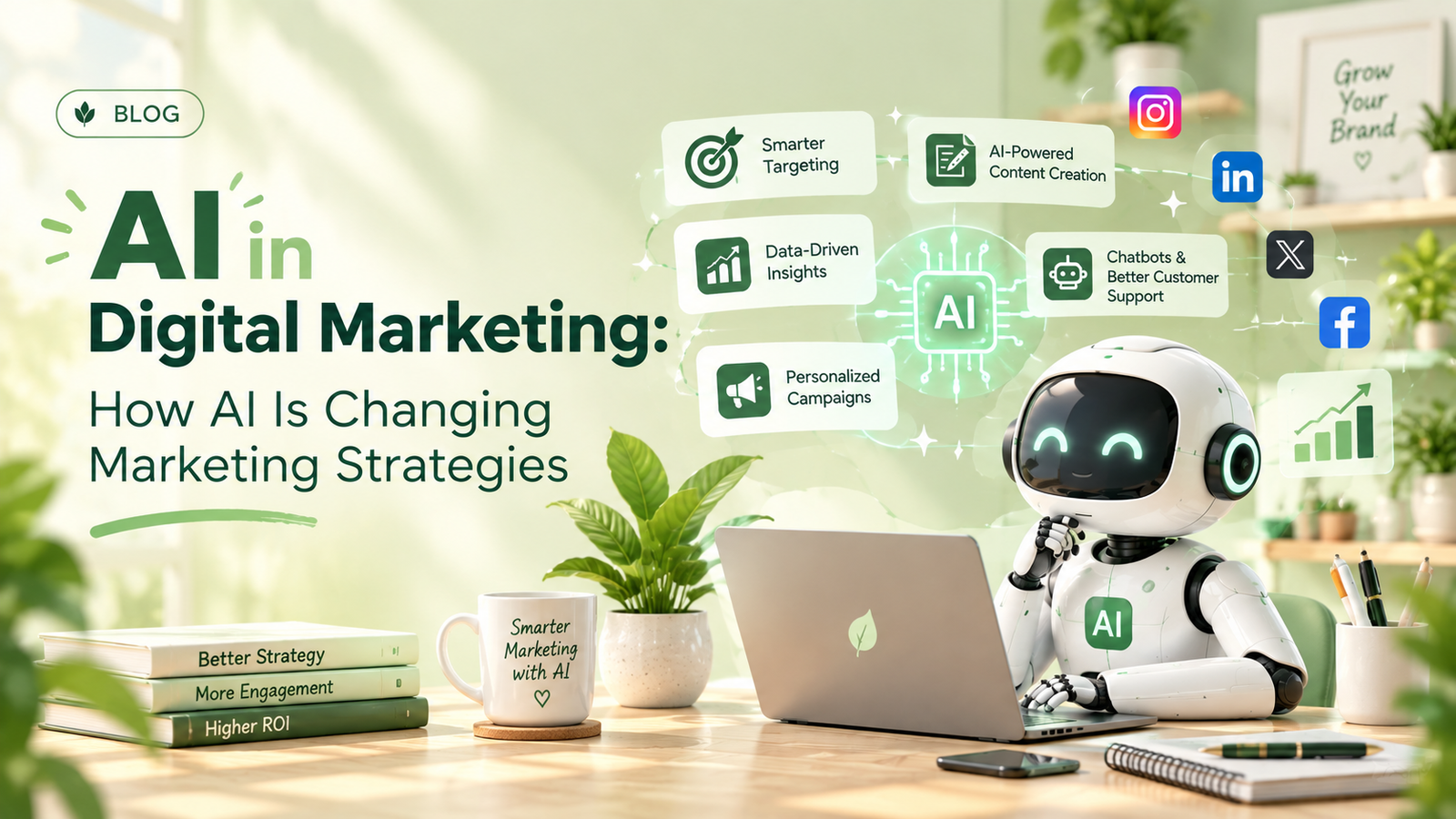
AI in Digital Marketing: How AI Is Changing Marketing Strategies
INTRODUCTION
Artificial Intelligence (AI) is transforming the digital marketing landscape faster than ever. From personalized recommendations to automated customer support, AI is helping businesses understand their audiences, create better content, and make smarter marketing decisions.
Traditional digital marketing often requires marketers to spend significant time analyzing data, managing campaigns, creating content, and understanding customer behavior. AI-powered tools can now automate many repetitive tasks while providing valuable insights from large amounts of data.
However, AI is not simply about automation. Its real value lies in helping marketers deliver the right content to the right audience at the right time. As businesses compete for attention in an increasingly crowded digital space, understanding AI has become an important part of developing effective digital marketing strategies.
How AI Is Changing Digital Marketing
1. Personalized Marketing Experiences
Modern customers expect brands to understand their needs and preferences. AI makes this possible by analyzing customer data and identifying patterns in their online behavior.
AI can analyze information such as:
Search and browsing behavior
Previous purchases
Website interactions
Content preferences
Customer interests
Engagement patterns
Based on these insights, businesses can create personalized product recommendations, emails, advertisements, and website experiences.
For example, an e-commerce website can recommend products based on what a visitor has previously searched for or purchased. This creates a more relevant experience and can improve customer engagement.
2. AI-Powered Content Creation
Content marketing is one of the most important parts of digital marketing, but consistently producing quality content can be time-consuming. AI tools can support marketers by generating ideas, creating initial drafts, writing social media captions, and developing advertising copy.
AI can assist with:
Blog topic ideas
Social media posts
Email content
Product descriptions
Ad copy
Content outlines
However, human creativity remains essential. AI-generated content should be reviewed, edited, and improved by marketers to ensure that it is accurate, original, useful, and aligned with the brand’s voice.
The best approach is to use AI as a marketing assistant, not as a complete replacement for human creativity.
3. Smarter SEO Strategies
Search Engine Optimization (SEO) is also being influenced by AI. Marketers can use AI-powered tools to discover keyword opportunities, analyze search trends, understand user intent, and identify content gaps.
AI can help marketers understand what their target audience is searching for and what type of information they expect to find.
This is particularly important as search behavior continues to evolve. People are increasingly using conversational queries and asking search engines complete questions rather than relying only on short keywords.
As a result, modern SEO requires more than keyword placement. Businesses need to create helpful, relevant, and trustworthy content that genuinely answers users’ questions.
4. AI Chatbots and Customer Support
AI-powered chatbots are changing the way businesses communicate with their customers. They can answer common questions, provide product information, guide website visitors, and assist with basic customer service.
One of the biggest advantages of AI chatbots is their ability to provide support around the clock.
For example, a customer visiting an online store outside business hours can ask about shipping, product availability, or return policies and receive an immediate response.
This can improve the customer experience while allowing human support teams to focus on more complicated issues.
5. Data Analysis and Marketing Insights
Digital marketing generates huge amounts of data every day. Understanding this data manually can be difficult and time-consuming.
AI can process large datasets and identify patterns that can help marketers understand:
Customer behavior
Website performance
Campaign results
Conversion trends
Audience interests
Content engagement
These insights allow businesses to make more informed, data-driven decisions. Instead of relying only on assumptions, marketers can use real-time information to understand what is working and where improvements are needed.
6. Smarter Digital Advertising
AI is making online advertising more efficient by helping businesses understand which audiences, messages, and creatives are most likely to generate results.
AI-powered advertising systems can analyze campaign performance and help optimize factors such as audience targeting, ad placement, creative variations, and budget allocation.
For example, if one advertisement generates more engagement or conversions than another, AI-based systems can identify performance differences and support campaign optimization.
This allows marketers to spend their advertising budget more strategically.
7. Predictive Marketing
One of the most powerful applications of AI is predictive analytics. Instead of only analyzing what customers have done in the past, AI can identify patterns that may indicate future behavior.
Businesses can use predictive insights to identify:
Customers who may purchase again
Products that may become more popular
Potentially high-value leads
Customers who may stop engaging
Opportunities for targeted campaigns
This helps marketers plan campaigns proactively rather than simply reacting to past results.
8. Social Media Marketing
Social media platforms generate a continuous stream of customer interactions and conversations. AI can help marketers analyze this information and identify trends, audience interests, and content performance.
AI tools can support marketers with content ideas, audience analysis, social listening, and performance insights.
For example, by analyzing comments and engagement patterns, a business can identify the topics its audience is most interested in and create future content around those interests.
The Future of AI in Digital Marketing
AI will continue to play an important role in the future of digital marketing. As technology develops, businesses will have more opportunities to automate repetitive tasks, understand customer behavior, and create highly personalized experiences.
At the same time, successful marketing will still depend on human creativity, strategy, empathy, and ethical decision-making. AI can provide data and suggestions, but marketers must decide how to use those insights responsibly.
The future is therefore not simply AI replacing marketers. It is about AI and marketers working together to create more effective and meaningful digital experiences.
Conclusion
Artificial Intelligence is reshaping digital marketing by making it more personalized, efficient, data-driven, and customer-focused. From SEO and content creation to chatbots, advertising, social media, and predictive analytics, AI is giving marketers powerful new ways to understand and connect with their audiences.
For businesses, learning how to use AI effectively can create new opportunities to improve marketing performance and customer experiences. However, technology alone is not enough. The strongest strategies will combine AI-powered insights with human creativity, critical thinking, and marketing expertise.
As digital marketing continues to evolve, AI will not just be another marketing tool. It will become an increasingly important part of how brands communicate, compete, and build lasting relationships with their customers.